The "25mm Rule": Time & Depth Determine Weed Control Success
For years, UK councils have been caught in a frustrating loop: trialling "non-chemical" weed control methods, seeing them "fail" to kill established weeds, and then reverting to chemical spraying. But
The 25mm Rule: Why Time & Soil Depth Dictate Weed Control Success
By Sean Faulkner, Kersten UK
For years, UK councils have been caught in a frustrating loop: trialling "non-chemical" weed control methods, seeing them "fail" to kill established weeds, and then reverting to chemical spraying. But data from the Bracknell Town Council Trial proves we have been diagnosing the problem incorrectly. The failure isn't the machine; it’s the lack of normalization.
Most council trials treat all weeds as equal. They aren't. Our statistical research proves that success depends entirely on two variables: Soil Depth and Silt Maturity. If your trial doesn't normalize for these, you aren't testing a weed control strategy; you are simply measuring the level of previous asset neglect.
The Science: It’s Not Just Dirt, It’s "Ecological Succession"
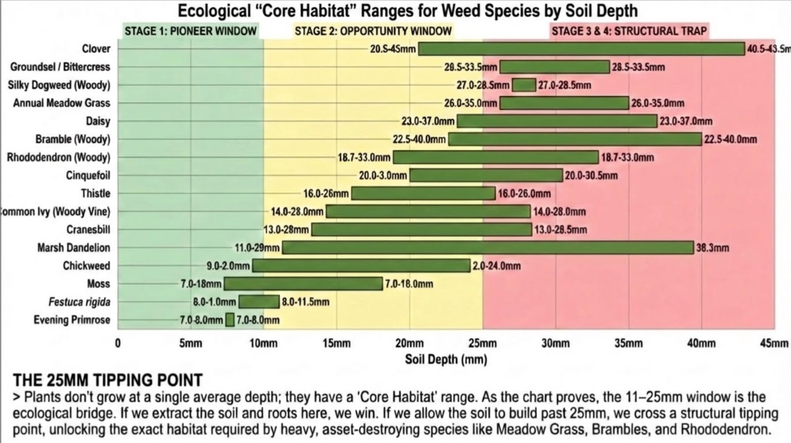
Weeds don't just appear randomly. They follow a mathematically predictable timeline based on how deep the soil has accumulated on your pavement.
We call this "Pavement Ecological Succession." Through rigorous statistical testing (Kruskal-Wallis and Chi-Square analysis) of the Bracknell trial data, we confirmed with 99.99% certainty that specific weeds are ecologically restricted to specific soil depths.
It is critical to distinguish between Volume (how much dirt is there) and Anchorage (where the roots are). A 20mm silt bed that arrived last winter is biologically different from a 20mm silt bed that has been there for three years.
The "Floating" vs. "Anchored" Root
- The Floating Root (Recent Accumulation): When silt accumulates quickly (e.g., over one winter), intermediate weeds like dandelions, plantain, and cranesbill will germinate into the silt. Crucially, their roots are effectively "floating" in the soil matrix on top of the hard surface.
- Mechanical Outcome: A heavy brush lifts the silt, the weed, and the entire root crown cleanly off the pavement. 100% Extraction.
- The Anchored Root (Aged Accumulation): If that same silt is left for a second growing season, the root system seeks moisture. It finds the microscopic cracks in the asphalt and drives the taproot through the surface and into the sub-base, exacerbating freeze-thaw damage.
- Mechanical Outcome: The brush removes the silt and snaps the top off the weed. The "engine" (the root) remains safe underground. Regrowth is guaranteed.
The Intervention Window: The "Use It or Lose It" Phase
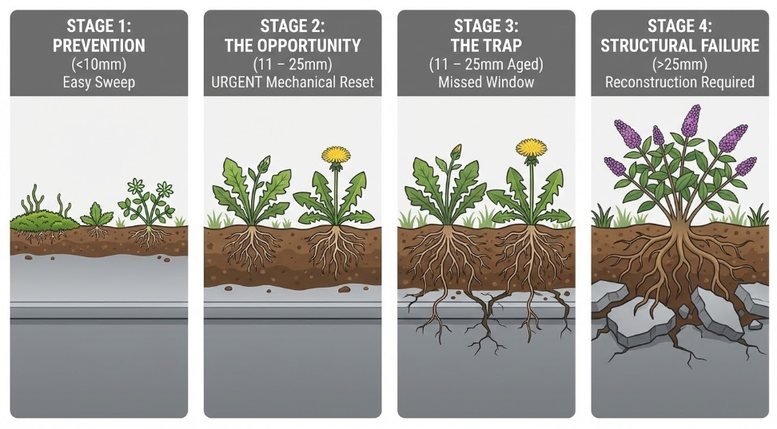
The Bracknell data mathematically identifies the 11mm–25mm depth as the critical "Intervention Window." But this window is a timer, not a fixed state.
- Category 1 (Prevention): Soil <10mm. The pioneer stage. 100% of moss and shallow chickweed are found here. Action: Easy Sweep / Reset.
- Category 2 (The Opportunity): Soil 11–25mm (Recent). The herbaceous weed boom (dandelions, meadow grass). Roots are established but "floating." Action: URGENT MECHANICAL RESET. You can still remove the problem successfully.
- Category 3 (The Trap): Soil 11–25mm (Aged). Roots have anchored into the tarmac. You have missed the chronological window. Action: You are now managing a structural defect, not a weed problem.
- Category 4 (Structural Failure): Soil >25mm. The data shows over 66% of woody perennials (Buddleia, Brambles) establish here. Roots are lifting the asphalt. Action: The asset requires reconstruction.
This is why trials fail. If you trial a mechanical brush on a "Category 3" street, it will look like a failure. Not because the brush is weak, but because you missed the chronological window to intercept the root before it became part of the road.
The Financial Case: Maintenance vs. Capital Repair
We are moving the conversation from "Horticulture" to "Civil Engineering."
- Preventative Surface Treatment (Category 1 & 2): Normally <£10 per m²
- Resurfacing After Structural Root Failure (Category 3 & 4): Often >£100 per m²
By ignoring the Time Factor and the 25mm soil depth threshold, councils aren't saving money; they are effectively choosing to pay the "Capital Repair" price. Every month a 20mm silt bed sits on the road, it moves closer to becoming a structural liability.
The 15-Minute Diagnostic Protocol
Stop guessing. Before you deploy a machine, categorize your streets using the Bracknell Matrix:
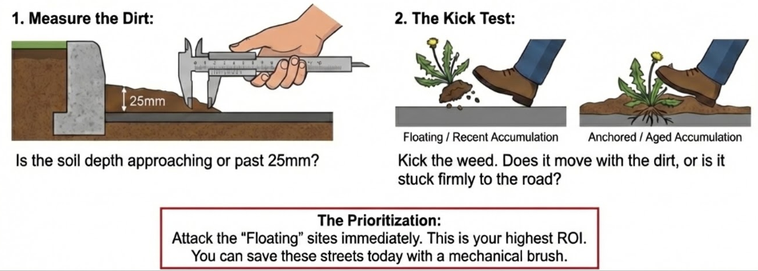
- Measure: Is the soil depth approaching or past 25mm?
- Kick Test: Kick the weed. Does it move with the dirt (Floating/Recent)? Or is it stuck to the road (Anchored/Aged)?
- Prioritize: Attack the "Floating" (Category 2) sites immediately. This is your highest ROI. You can save these streets today. If you wait until next year, you will have to rebuild them.
Don't Let Intervention Sites Become Reconstruction Projects
The difference between a <£10/m² maintenance intervention and a >£100/m² reconstruction isn't the weed control method you choose, it's when you intervene. Every month that 25mm of silt sits on your kerb line, perennial roots are working through microscopic cracks. Once those roots anchor into the sub-base, you haven't just missed an opportunity to control weeds efficiently; you've inherited a structural defect that mechanical treatment cannot reverse.
Take Action This Week
Step 1: Identify Your Intervention Window Sites
Use the kick test on a representative sample of your network. Sites where perennials move with the dirt when kicked are still in the intervention window. These are your highest-ROI opportunities.
Step 2: Understand the Complete Framework
The Bracknell trial data reveals the full relationship between soil depth, establishment duration, and treatment outcomes:
Read the Complete Bracknell Trial Findings →
This includes the detailed methodology, site-by-site data, and the four-category diagnostic framework that councils can apply to their own networks.
Step 3: Plan Your NAP 2025 Compliance Strategy
The National Action Plan 2025 requires councils to reduce pesticide reliance, but most haven't connected this requirement to their infrastructure protection obligations under EPA 1990 Section 89.
Download the NAP 2025 Council Implementation Guide →
This guide shows how mechanical prevention fulfills both your pesticide reduction targets AND your statutory cleansing duties, while protecting infrastructure integrity.
Get Expert Assessment of Your Network
Not sure whether your sites are in Category 2 (intervention window) or Category 3 (aged accumulation)?
Sean Faulkner offers evidence-based site assessments for councils and large estates:
Request Your Site Assessment →
Call: 0118 986 9253
The Bottom Line
If your mechanical weed control trials have "failed," ask yourself: were you testing on floating root sites (recent accumulation) or anchored root sites (aged accumulation)?
The Bracknell data proves mechanical extraction works; when deployed at the right stage of pavement ecological succession.
Don't waste another budget cycle treating symptoms. Use the diagnostic framework to identify which sites you can still save, and which sites need reconstruction planning.
The intervention window doesn't stay open forever.

No comments yet. Login to start a new discussion Start a new discussion